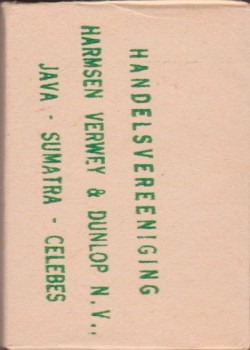
A of playing cards dating to circa 1890, housed in its original printed paper wrapper. The pack contains a total of 60 narrow playing cards, typical for the game of Ceki pr Chi Chi Pai popular in Southeast Asia. Each card measures 6 x 3 cm (approx. 2.4 x 1.2 inches) and is printed on cardstock in two colors (red and black) with square corners. Manufactured in Belgium, these cards were produced for the Dutch trading company Handelsvereeniging Harmsen Verwey & Dunlop N.V. for export and sale in the Dutch East Indies, with the wrapper explicitly listing the target markets: "JAVA - SUMATRA - CELEBES" (now Indonesia). A significant example of specialized European production for Asian colonial markets during the late 19th century.
An exceptionally interesting and well-preserved example of late 19th-century playing cards, specifically produced for export to the Asian market. Dated circa
1890, this pack represents a fascinating intersection of European manufacturing, Dutch colonial trade, and Southeast Asian gaming culture.
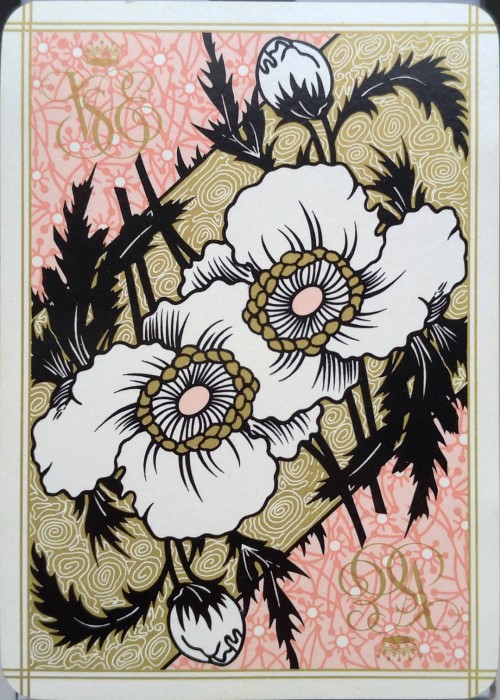
The Cards: The pack contains a complete set of 60 narrow playing cards, characteristic of decks used for the popular game of Ceki (also known as Cheki and Chi Chi Pai), widely played in communities across Indonesia, Malaysia, and Singapore. Each card is made from cardstock with square corners and measures precisely 6 x 3 cm (approx. 2.4 x 1.2 inches). The designs are printed in two traditional colors, red and black, featuring motifs typical of Chinese-influenced "money-suited" decks common in the region.
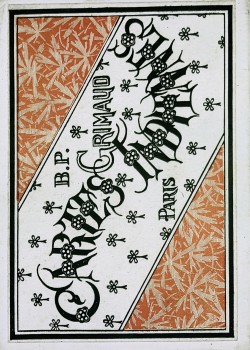
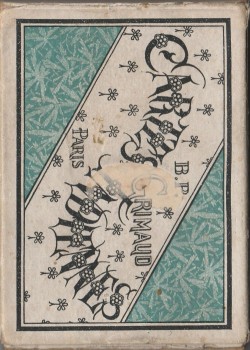
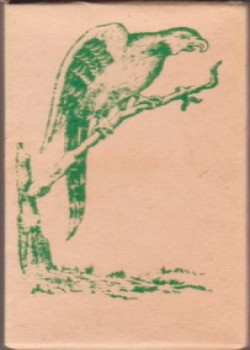
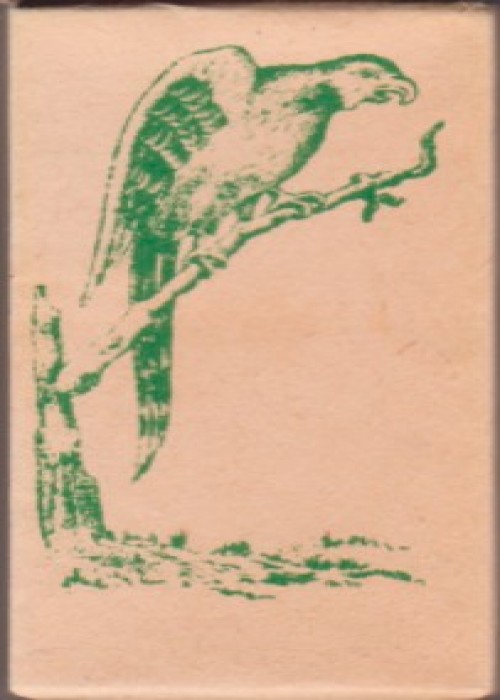
The Packaging: The cards are housed in their original printed paper wrapper. This wrapper is crucial as it identifies the distributor: the prominent Dutch trading company "HANDELSVEREENIGING HARMSEN VERWEY & DUNLOP N.V." (Handelsvereeniging meaning Trading Association). Crucially, it explicitly lists the intended colonial markets within the Dutch East Indies: "JAVA - SUMATRA - CELEBES" (now major islands of Indonesia). The wrapper also features a stylized graphic printed in green, possibly intended to evoke Asian motifs.
Origin and Context: While distributed by a Dutch company for the Dutch colonies, the cards themselves were almost certainly manufactured in Belgium, likely in the major playing card production hub of Turnhout. Belgium was a world leader in producing playing cards for export during this period, often creating specific designs tailored to foreign markets. This pack is a prime example of this practice – European manufacturing meeting the specific demands of consumers in Asia, facilitated by colonial trading networks. It serves as a tangible artifact of global commerce and cultural exchange during the late colonial era.